I used to leave meetings with pages of notes and a vague sense that something important had been decided. By the next morning the sense was gone and the notes had turned into a wall of text I did not want to reopen. The actions that actually needed to happen were buried between discussion points, half-formed ideas, and jokes that made sense only in the room.
The fix was not better handwriting or a fancier note-taking app. It was a small set of prompts that forced the messy notes into a usable shape while refusing to invent decisions that had never been made. Over time those prompts settled into twelve variations I rotate depending on the kind of meeting and the kind of notes I have.
None of them are magic. All of them are short enough to test and clear enough to adapt. Here they are, grouped by the job they do, with the baseline version first and the most useful variations afterward.
The Core Problem These Prompts Solve
Meeting notes fail in predictable ways. They mix decisions with discussion. They omit owners. They record “we should probably…” as if it were a commitment. They bury the one action that matters under three paragraphs of context.
A good prompt for this task does three things:
Extracts only what was clearly agreed or assigned
Leaves blanks instead of guessing
Surfaces ambiguity instead of hiding it
Every prompt below is built on that standard. I start with the smallest useful version and only add structure when the notes themselves demand it.
Baseline Prompt (Use This First)
Turn these meeting notes into a short list of next actions.
For each action include:
What needs to be done
Who is responsible (only if stated)
Any deadline mentioned
If ownership or timing is not stated, leave those fields blank.
Do not turn discussion points or suggestions into actions.
This is the version I reach for most often. It works on rough notes, partial notes, and notes taken by someone else. When it fails, the failure is usually visible: too many blanks, or an action that still feels fuzzy. That visibility is useful.
Variation 1: Strict Decision Filter
Use when the meeting produced many “we should” statements but few real commitments.
Extract only the actions that were clearly decided or assigned in these notes.
Ignore suggestions, ideas, and open discussion.
List each action with owner and deadline only when those details appear in the notes.
If nothing meets the standard, say so.
Variation 2: Owner-First List
Use when the same people appear repeatedly and you need to see workload at a glance.
From these meeting notes, list next actions grouped by person.
Only include actions that were clearly assigned.
Under each name, show the action and any stated deadline.
If an action has no owner, put it in a final section labeled “Unassigned.”
Variation 3: Deadline-Sensitive Version
Use when timing is the main risk.
Pull every next action from these notes that has a stated or implied time element.
Show the action, the owner if named, and the timing language exactly as written.
Flag any action that sounds time-sensitive but has no date or timeframe.
Variation 4: Ambiguity Spotlight
Use when the notes are especially messy or incomplete.
Review these meeting notes and produce two lists:
Clear next actions (with owner and deadline only if stated)
Items that sounded like actions but are still too unclear to assign
Do not resolve the unclear items. Just surface them.
Variation 5: Recurring Meeting Tracker
Use for weekly or standing meetings where you need continuity.
Compare these new notes with the previous action list I will paste below.
Produce an updated list that shows:
Completed or dropped items
Still-open items
New actions from today’s notes
Only mark something complete if the notes explicitly say it is done.
(You paste the previous list after the prompt.)
Variation 6: Minimal Output for Busy Readers
Use when the recipient will only look at the actions for ten seconds.
From these notes, list the next actions in the shortest possible form.
One line per action.
Include owner and deadline only when both are stated.
No extra commentary.
Variation 7: Context-Preserving Version
Use when the action only makes sense with a brief reason.
Extract next actions from these notes.
For each action, add one short clause explaining why it matters or what decision produced it.
Keep the clause under ten words.
Still leave owner and deadline blank when they are missing.
Variation 8: Cross-Team Handoff
Use when actions will be read by people who were not in the meeting.
Turn these notes into a handoff list for people who did not attend.
For each action include:
The action itself
Who owns it (if stated)
Any deadline
One sentence of necessary context
Do not assume prior knowledge.
Variation 9: Risk and Dependency Flag
Use when the meeting touched on blockers.
List the next actions from these notes.
After the main list, add a short section called “Dependencies or Risks Mentioned” and record any blockers, waiting items, or risks exactly as they appeared.
Do not invent new risks.
Variation 10: Personal Action Extract
Use when you only need what you yourself must do.
From these meeting notes, extract only the actions assigned to me or that I volunteered for.
List them with any stated deadlines.
Ignore everything assigned to other people.
(You can replace “me” with a specific name.)
Variation 11: Table Format for Scanning
Use when the list will be pasted into a shared document or tracker.
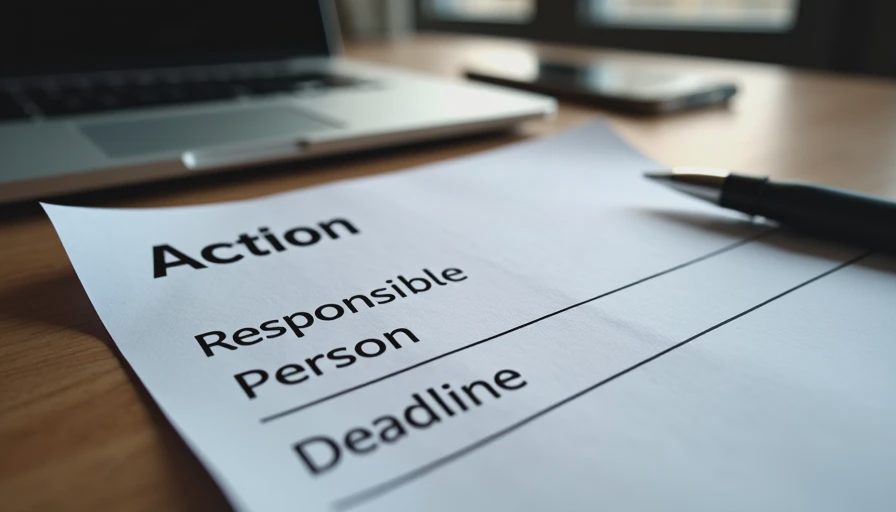
Convert these meeting notes into a simple table with three columns:
Action | Owner | Deadline
Leave Owner or Deadline cells empty when the information is not in the notes.
Do not add rows for discussion items that were not decided.
Variation 12: Full Safety Version
Use when the stakes are higher and you want maximum protection against invented commitments.
Read these meeting notes carefully.
Produce a list of next actions that meets all of the following rules:
The action was clearly agreed or assigned
No owner is added unless named
No deadline is added unless stated
No action is created from a suggestion or “we should” statement
Any item that feels close to an action but fails the rules goes into a separate “Needs Clarification” list
This is the version I use when the notes will be forwarded to clients or senior stakeholders.
How to Choose and Adapt
I do not memorize all twelve. I keep the baseline and two or three variations that match the meetings I have most often. The rest stay in a note file for the days when the usual versions are not enough.
When I adapt a prompt, I change only one element. If I need both a table format and a stricter decision filter, I test them separately first. Combining untested changes makes it impossible to know which part improved the result and which part quietly broke something else.
A practical way to start: pick the baseline and Variation 4 (Ambiguity Spotlight). Run both on the same set of real notes. See which output you would actually send to the team. That single comparison usually teaches more than reading another list of templates.
A Note on What These Prompts Cannot Do
They cannot repair a meeting that never reached a decision. They cannot remember context that was never written down. They cannot turn a room full of nods into documented commitments if no one said the words out loud.
In those cases the honest output is a short “Needs Clarification” list. That result is more useful than a polished action list that never happened.
Human review remains the final step. I read every output the same way I would read a junior colleague’s summary: keep what is accurate, correct what drifted, and refuse to publish anything that invents agreement.
Working Method Summary
Start with the smallest useful version—the baseline.
Test it on real notes before adding structure.
Add only the constraints that solve a problem you have already seen.
Keep the original short version even after you improve it.
Treat every successful run as information, not proof.
Clear next steps beat comprehensive notes. The prompts above exist to make that trade-off deliberate instead of accidental. Use the baseline first. Expand only when the notes themselves demand it. And when in doubt, leave the blank instead of filling it with a guess.


No notes on this sheet yet.